 Isuru
Isuru The founder of a direct-to-consumer e-commerce brand came to me with a good problem. His team was five people, and he wanted to be at fifteen by the end of the year. He’d already sorted out his tools: Asana for projects, Drive and Dropbox for files, Frame.io for creative review. What he didn’t have was a home for how the company actually ran.
Every time someone joined, onboarding turned into a week of Loom links, Slack screenshots, and “ask Sarah, she knows.” The few SOPs that existed were scattered across Google Docs. He could feel this breaking somewhere around ten people, and he wanted Notion to be the company’s brain before it did.
The Challenge
Their knowledge base was really just a Drive folder. Training was whoever happened to have time that week. The problem wasn’t that information was missing; it was that nobody could find the information they already had. A support agent looking for the refund process would end up messaging the founder. A new hire learning the creative review workflow would get three different answers from three different people.
The tricky part was that the founder already had a toolset he was happy with. Notion wasn’t there to replace any of it. It needed to own documentation and knowledge, and stay out of the way of everything else.
What I Built
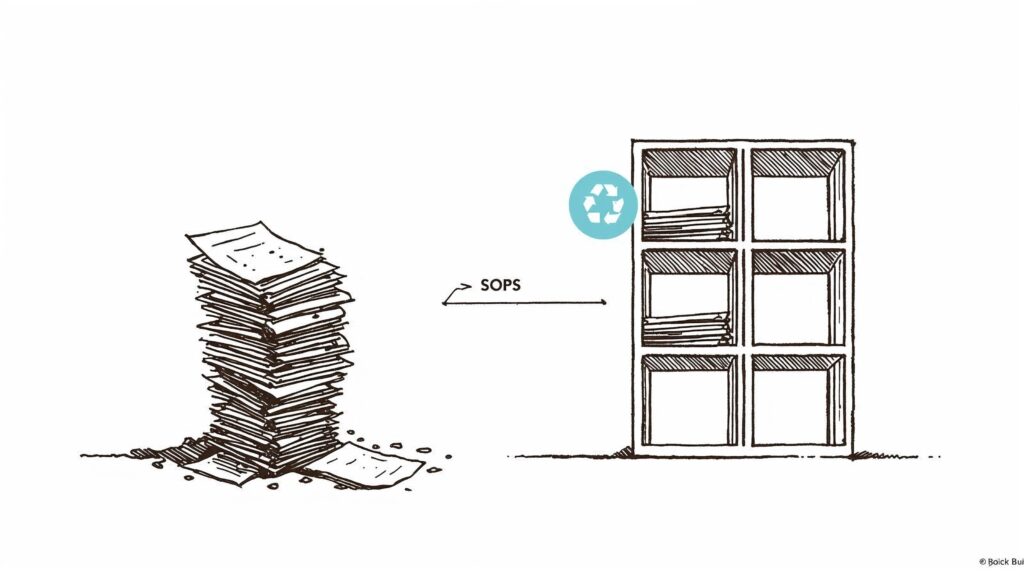
The foundation was one decision: build it department-first. The founder asked early on whether a single shared SOP database could serve every team. I said no, and it turned out to be the most important no in the whole project. Shared databases look tidy at first and slowly turn into landfills. Customer Support’s refund docs bleed into Operations, the filters get fiddly, and eventually people stop trusting the search and go back to asking each other.
So each department got its own space: Company HQ, Knowledge Base, Marketing, Customer Support, Operations, and Hiring & Training, with a Team Directory, Resources, and Training running across all of them. Each team sees what’s theirs day to day, and leadership can still search across everything from one place.
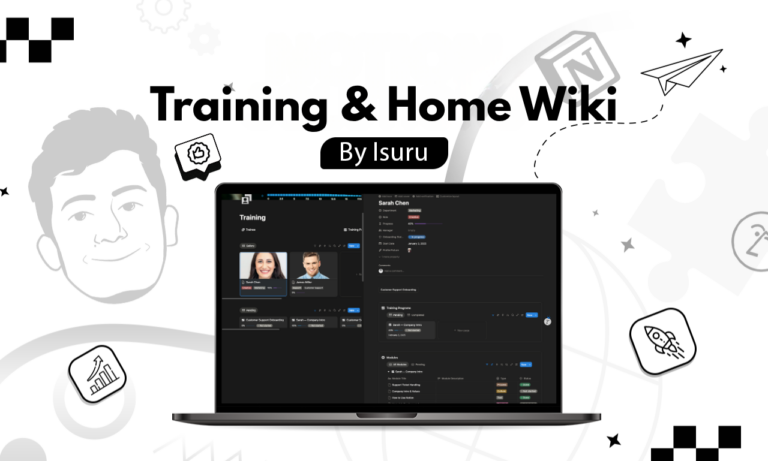
For training, I wanted something that tracked whether people actually finished, rather than a folder of documents anyone could quietly ignore. When a new hire starts, the founder picks their role and the right training modules get assigned automatically. Each person gets a simple dashboard of their modules and how far along they are, and the founder gets one view of onboarding progress across the whole team.
I also kept Notion deliberately out of the production pipeline. Asana still owns tasks and Frame.io still owns video feedback. The Marketing space holds strategy, creative concepts, and references, and once something is ready it hands off to Asana. No double-entry, and every tool stays in its lane.
The last piece is what keeps a wiki alive. Every SOP has an owner, a verified status, and a last-updated date. If something hasn’t been checked in 90 days, it surfaces on the dashboard as needing review. It is a small thing, but it is the difference between a wiki people still trust a year later and one that quietly goes stale.
The Result
The team moved in with a clear map of where everything lives. New hires get structured training with tracked progress instead of ad-hoc explanations, and the founder has one place to see if SOPs are current, who owns what, and where the gaps are. The workspace is built to hold 20+ people without a rebuild.
The clearest sign it worked came on the second review: the only real addition he asked for was a creative performance database to track hooks, angles, editors, spend, and results over time. Everything else landed on the first pass.
The Part That Mattered Most
The best decision here wasn’t a clever feature. It was drawing a clear boundary and holding it. Choosing what Notion would not do, and giving each department its own space, is the kind of quiet call that barely shows up in a demo but is the whole reason the workspace still works when the team doubles.